
BMS
A fully domestic, Japan-made BMS built around Texas Instruments (USA) semiconductors, spanning everything from PCB to firmware. Safely powering drones, eVTOLs, and data center BBUs.
Keep it flying, moving. Never let it stop.
And keep that power safe.
A BMS (Battery Management System) is the control system that lets a battery made up of multiple cells be used safely and efficiently.
Built around semiconductors from Texas Instruments (TI, USA), TEKJP develops fully domestic, Japan-made BMS units and chargers from the ground up for each application—covering everything from PCB design to firmware source-code development. By combining high-precision SoC estimation based on TI's Impedance Track™ technology with warning detection driven by our proprietary firmware, we deliver BMS units for the high-reliability battery modules that drone flight safety depends on.
With cell balancing—equalizing the voltage of each cell during charging—as our core technology, we design boards tailored to the required output range, safety requirements, and communication specifications, from small airframes such as drones to data center backup power.
Areas of development
TEKJP develops BMS solutions tailored to the differing requirements of each application. Voltage range, capacity, redundancy, and operating environment vary widely from one use case to the next, but the core common to every project is the same: understanding cells accurately and managing them safely.

Drones
For industrial drones, we develop BMS units and chargers in 6S–18S configurations. Beyond being lightweight and high-output, they couple tightly with the flight controller through our proprietary CAN / DroneCAN support, monitoring cell status at high speed during flight.
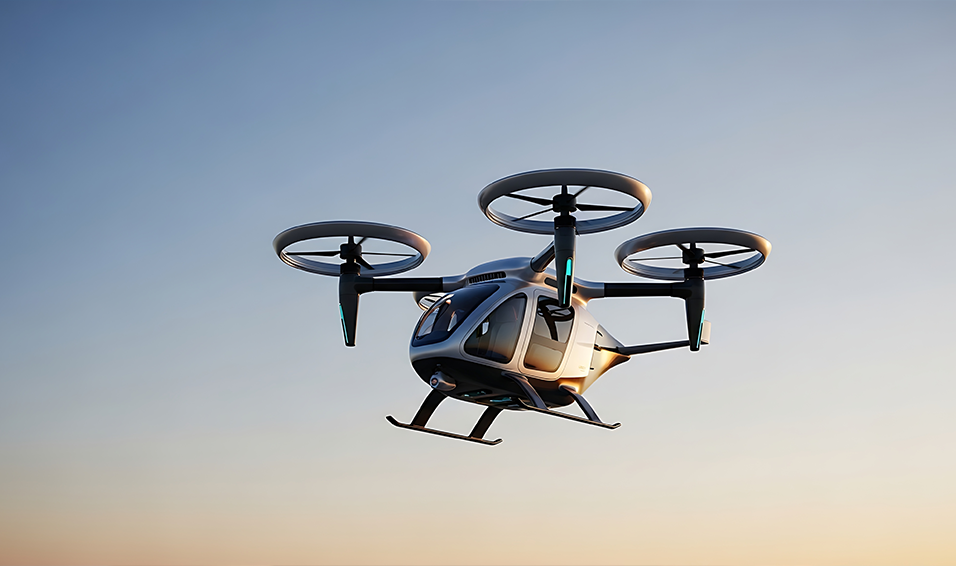
eVTOL
For electric vertical take-off and landing aircraft (eVTOL) and electric helicopters, we develop high-voltage BMS units exceeding 100S. We design with redundancy capable of withstanding manned flight, and with a focus on the high reliability that aviation safety directly depends on.

Data Center BBU
For AI data centers, we are developing BMS units for large BBUs (battery backup units) with the OCP standard in view. We are advancing support for 800V-class high-voltage and highly parallel configurations, delivering designs that ensure reliable operation during momentary outages and power faults.
Core technologies
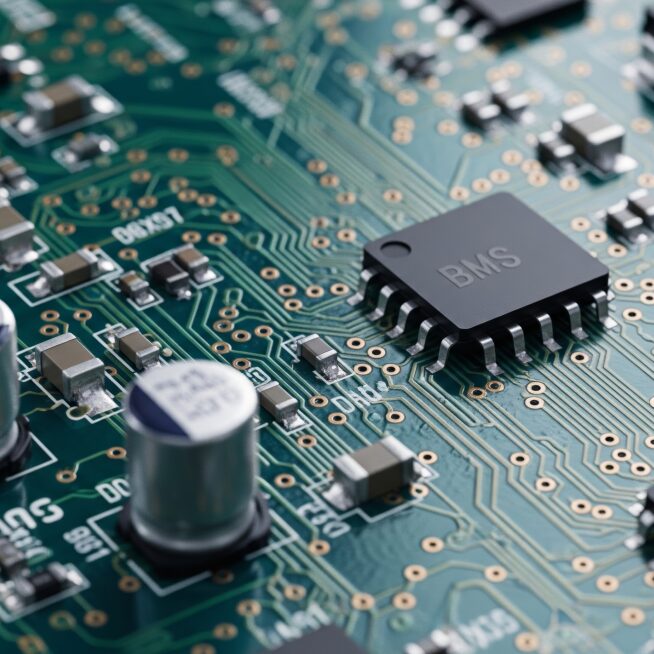
Whatever the application, TEKJP's BMS units share a common technical core: high-precision SoC estimation, cell-voltage balancing, support for high voltage and high current, and integrated development that extends all the way to the charger. We place importance on optimizing the battery not as a standalone unit, but as part of the power system as a whole.
High-precision SoC estimation and warning detection
Using TI's Impedance Track™ technology, we estimate state of charge (SoC) with high precision from the internal impedance of the cells. Combined with warning detection for overcurrent, overvoltage, temperature anomalies, and more via our proprietary firmware, this makes it possible to grasp battery status in real time, even during flight or operation.
Cell-voltage balancing
By equalizing the voltage of each cell during charging, we draw out full charge capacity while preventing load from concentrating on particular cells. Built on TI's BQ series, this is the core control technology of a BMS that supports a wide range of configurations, from 6S to over 100S.
High-voltage, high-current design
With our proven 75V class for drones as a foundation, we are expanding our design into the 400V and 800V classes. Optimized board design and thermal design also let us handle large currents on the order of several hundred amperes.
Integrated development with the charger
We develop not only the BMS but the charger as well, in-house. The BMS and charger coordinate over CAN communication to deliver optimal charge-profile control according to cell status. By designing the battery, BMS, and charger as a single integrated system, we make optimization for each application possible.
Looking ahead
This is an era in which battery technology itself is on the verge of major change. Building on the technical expertise cultivated in controlling lithium-ion batteries, TEKJP is advancing applications toward next-generation power systems.
VISION 01
Supporting hydrogen fuel cells
In addition to lithium-ion batteries, we are expanding our development scope to the control of hydrogen fuel cells. With an eye on industrial drones that require long flight times and large mobility platforms moving toward zero emissions, we are developing fuel-cell BMS that account for energy density, operating cost, and safety requirements.
VISION 02
Hybrid power systems
Hybrid power that combines lithium-ion batteries with fuel cells is another important area of development. For applications that demand long-duration operation, a configuration in which the fuel cell supplies base power while the lithium-ion battery handles peak power and emergency backup is effective. TEKJP is developing optimal control technology for such hybrid configurations.
VISION 03
Expanding into higher voltage ranges
From the 75V class we currently support, our next step is to move toward the 400V class and, beyond that, the 800V class. With an eye on deployment in AI data center BBUs and large industrial power supplies, we are strengthening the technology for insulation design, redundancy, and safety-standard compliance that higher voltages demand.
Build with us.
We're looking for people to build with us
We are hiring engineers who bring depth in a specialized field—circuit design, embedded software, power control, data control—while also being willing to step into adjacent areas. If you want to build things that actually work with your own hands, from design through implementation to verification, we'd love to talk with you.
Inquiries about BMS
Whether you'd like to discuss a development project,
have a technical question, or are interested in careers, please feel free to get in touch.